Field report
Chasing helium-3 from Valhalla to the Jovian cloud tops
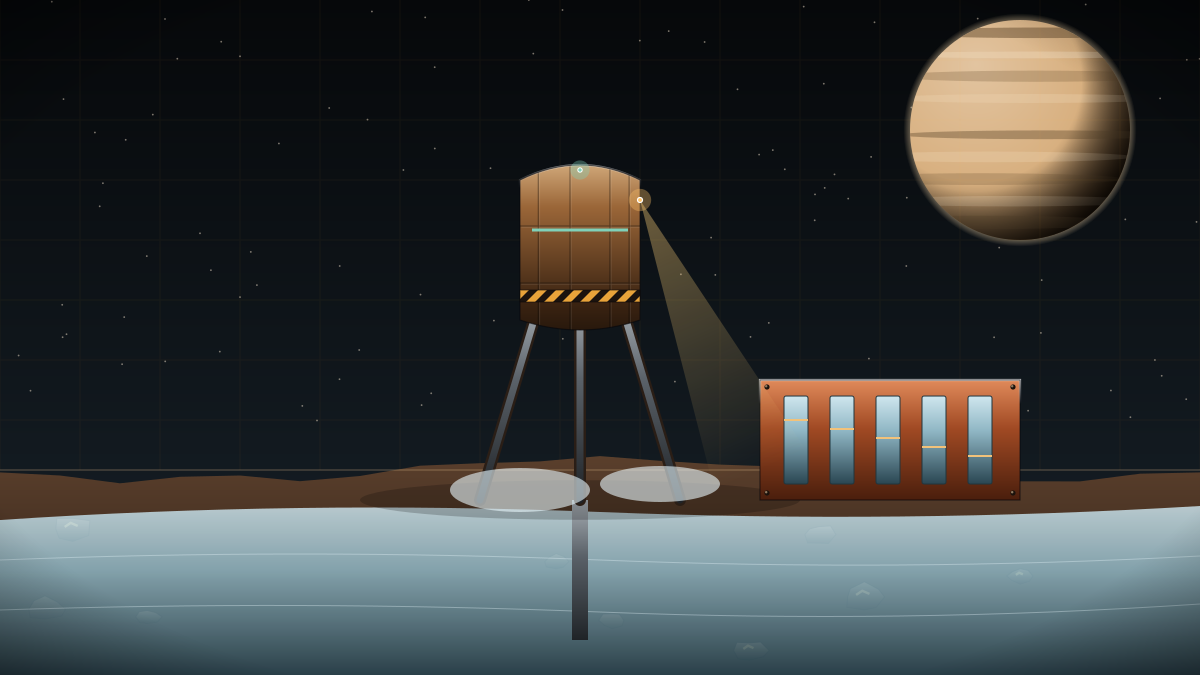
I have spent eleven years looking for an element you cannot see, smell or touch. Helium-3 is the fuel half the outer system dreams about, and near Jupiter it turns up in two very different places: locked into the coldest ice on Callisto, and spread thinly through the cloud tops of Jupiter itself. This season I worked both.
On Callisto we went to the Valhalla basin, where shadowed hollows stay cold enough to trap implanted solar-wind gases. A Cryo Ice-Core Sampler can bore 900 metres into ice, but here the prize sits in the top twelve metres of regolith, so we used it as a shallow, very careful sampler. Each core is sealed at minus 200 degrees before it leaves the hole, because warming it even slightly lets the helium escape. Our best cold traps assay at around 18 parts per billion helium-3 in ice that is 64 per cent water.
Eighteen ppb sounds like nothing, and for a single core it is. The trick is coverage. We scattered a pack of 64 Swarm Prospecting Beacons across 300 kilometres of the basin, and their thermal and neutron readings told us which hollows were worth coring. That cut our dry holes from two in three to roughly one in five.
The atmospheric side is a different job entirely. Our two Nimbus Gas Skimmers dip into the upper Jovian atmosphere, scoop gas, and bring back pressurised canisters for isotope analysis at Valhalla Station. The concentrations are higher, but every pass costs fuel and nerves, and the Jovian Helium-3 Consortium already holds most of the long-term skimming rights.
My honest verdict: the cold traps are a slow, cheap, patient resource that any small crew can stake, while skimming is a capital-heavy business best left to consortia. Valhalla is still open for staking. Come and see me at Valhalla Station if you want to try.