Equipment
Cryo Ice-Core Sampler
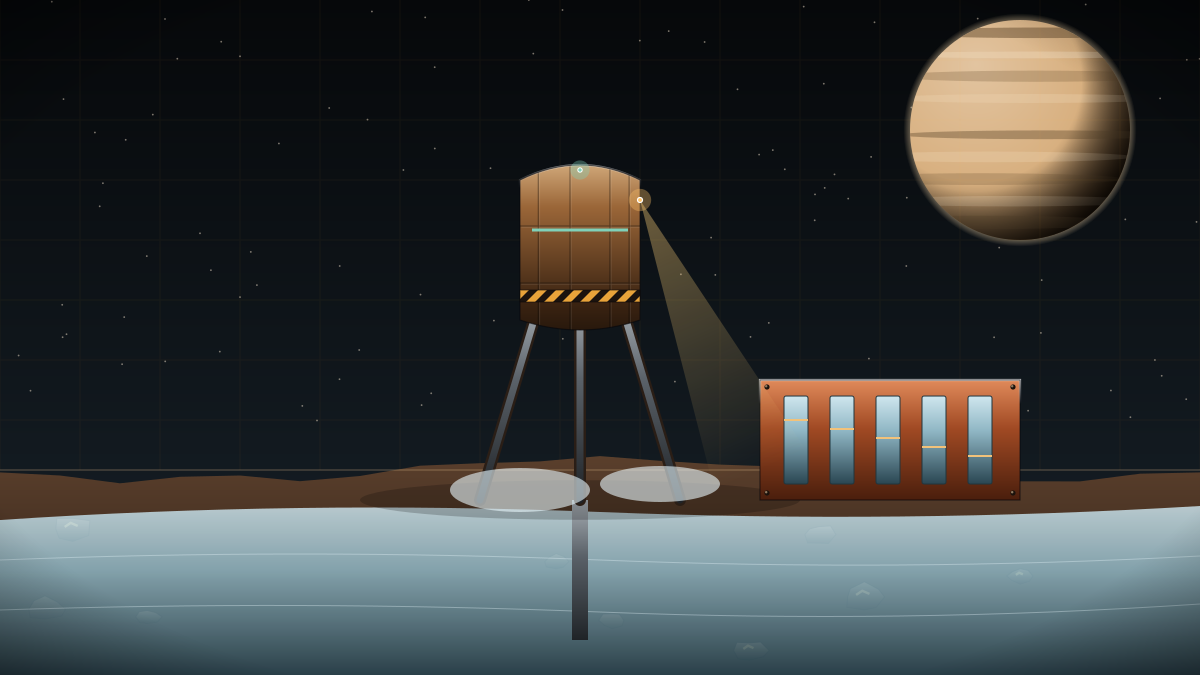
The ice shells of Jupiter's moons hold some of the most valuable volatiles in the outer system, including helium-3 implanted by the solar wind and Jovian plasma. Getting them out without boiling them away takes care. The Cryo Ice-Core Sampler was built for exactly that, and has been working the moons since 17 January 2182.
The sampler is a nine-metre sled with a thermal-mechanical drill: a heated tip melts a pilot channel while a chilled coring barrel captures the surrounding ice at minus 180 degrees, sealing each core in a vacuum canister before it can outgas. It reaches 900 metres in solid ice and can be towed up to 12 km between holes in a working day.
A plutonium-238 radioisotope generator supplies a steady 2.4 kW, essential in the deep cold and darkness. Two operators run the drill, with a third deployment crew member logging and packing cores. The 380 kg payload carries forty sealed core canisters and a portable mass spectrometer that gives a first helium-3 reading in parts per billion on the spot.
Cryo-Sampling Specialist Ylva Strand leads sampler crews on Europa, and the Jovian Volatiles Census is built almost entirely from Cryo cores. Helium-3 Prospector Paulo Teixeira pairs sampler data from the Valhalla Helium-3 Cold Traps with atmospheric readings taken by the guild's Nimbus Gas Skimmer, building a full picture of where helium-3 is concentrated around Callisto.
A sampler costs 3.1 million credits including the radioisotope lease. The Jovian Helium-3 Consortium operates seven and the Europa Subsurface Assay Institute nine.