Equipment
Swarm Prospecting Beacons
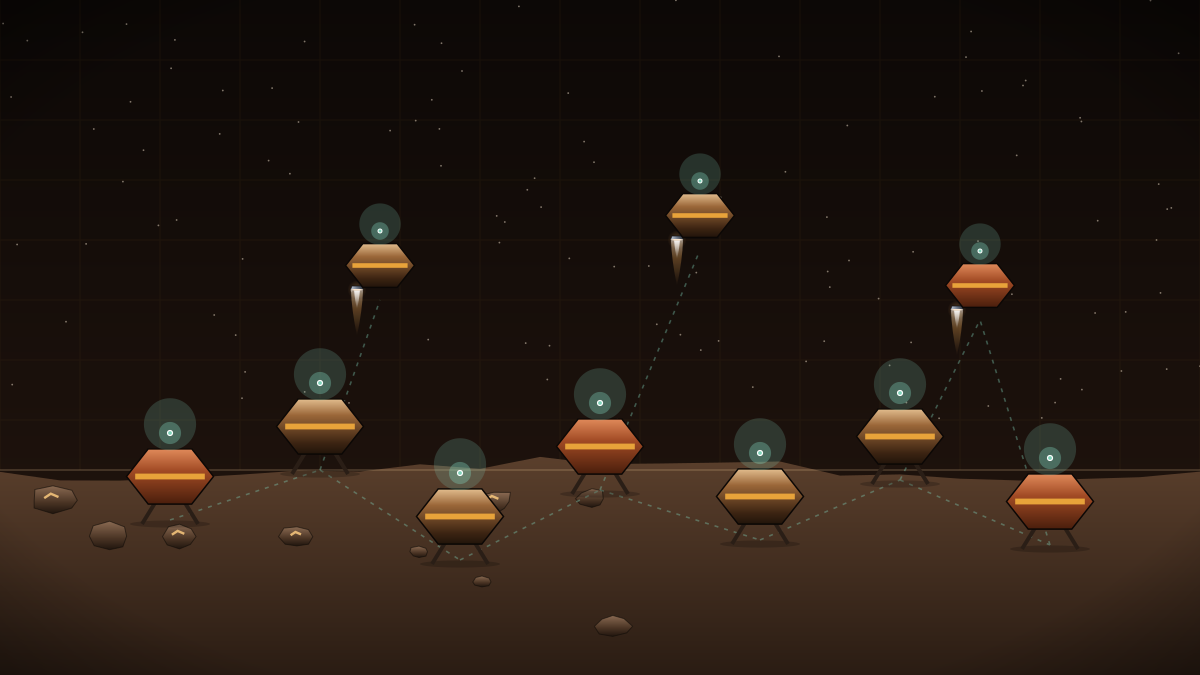
The Swarm Prospecting Beacons are the guild's newest experiment and still officially a prototype. Instead of one large instrument sweeping a body, a swarm puts dozens of small, cheap sensors on the surface at once and leaves them there, listening, for months.
A pack holds 64 beacons, each about forty centimetres across and weighing 1.5 kg; the whole pack masses 96 kg. Each carries a fluxgate magnetometer, a thermal probe, a micro-seismometer and a tiny mass spectrometer tuned for helium-3 and water vapour. Scattered from a Valkyrie Survey Corvette or a Wren Microlifter, they spread across a survey area of up to 300 km, and their spike-like feet sense down to roughly 150 metres using passive seismic and magnetic gradients.
Thin-film solar skins power the beacons, with betavoltaic cells to keep them alive through long nights; the whole swarm draws about 0.9 kW. They mesh-network with each other and relay summaries to a single operator, while a second crew member manages deployment and recovery. Beacons also double as temporary claim pickets, feeding positions into the ClaimGrid Boundary Mapper.
The first field swarm went down on 5 October 2186 around the Valhalla Helium-3 Cold Traps on Callisto, and the guild is planning a larger trial in the Belt. Early data is already part of the Belt Aeromagnetic Grid 2186 and the Jovian Volatiles Census.
A pack of 64 costs 1.9 million credits. Prototype packs are allocated to members and clients such as the Jovian Helium-3 Consortium in exchange for sharing their data.