Field report
Forty metres down at Cinder Tor: the first iridium cores
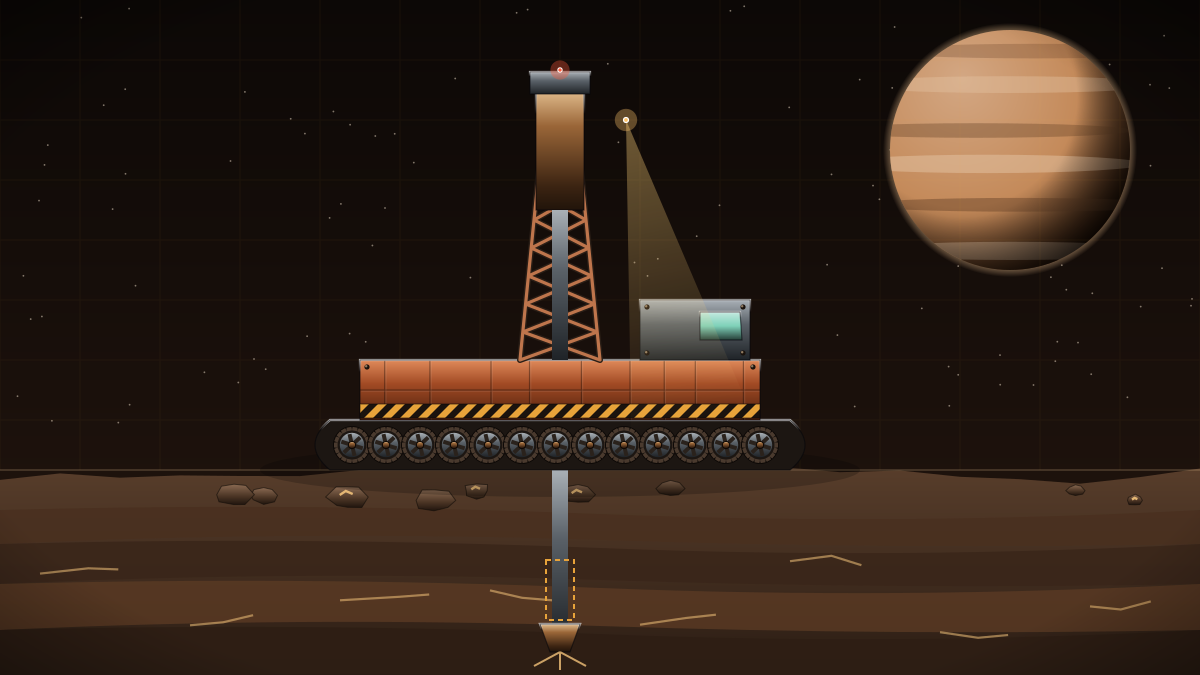
Every drill master remembers the first box of core from a new lode. Mine came up at 03:40 station time on the floor of the Rheasilvia basin, wet with cutting fluid and glittering in the floodlights, and the whole crew of six crowded round the tray like it was a birthday cake. That was hole CT-01, the first we have sunk into the Cinder Tor Iridium Lode on registered claim FV-0412.
We did not drill blind. Two seasons ago a Valkyrie Survey Corvette towed a Gravwell Gradiometer Array over this part of Vesta, and the density anomaly it found was so sharp that Liang Qiao at the Guildhall thought it was a processing artefact. It was not. The gradiometer put the top of a dense body at about 40 metres and its base somewhere past 300, and our holes now confirm both numbers to within a few metres.
The Corehound Deep Core Drill is rated to 2,400 metres, so a 310-metre hole is a gentle stroll for it. The real work is in keeping the core intact. Vesta's basin floor is shattered breccia over a fractured metal-rich layer, and broken core is useless core. We slowed the bit to forty revolutions a minute through the contact zone and switched to triple-tube barrels, which bought us 96 per cent recovery. The compact fission microreactor hummed along at its usual 420 kW and the 9.5-tonne core magazine filled twice before the Wren Microlifter came to fetch the boxes.
Imani Oduya's assay lab has now logged the first three holes. Across a 270-metre intercept the lode averages 14.2 grams per tonne iridium, 6.8 g/t osmium and 22 g/t platinum. For context, anything over 5 g/t combined platinum-group metal pays its way out here. Cinder Tor runs at roughly eight times that.
We have nine more holes planned on a 60-metre grid before the resource estimate goes to the Guild Council. If you are a member with drilling experience and a spare month, the Vesta roster has two open berths. Bring warm socks; the core shed is never heated.