Equipment
Gravwell Gradiometer Array
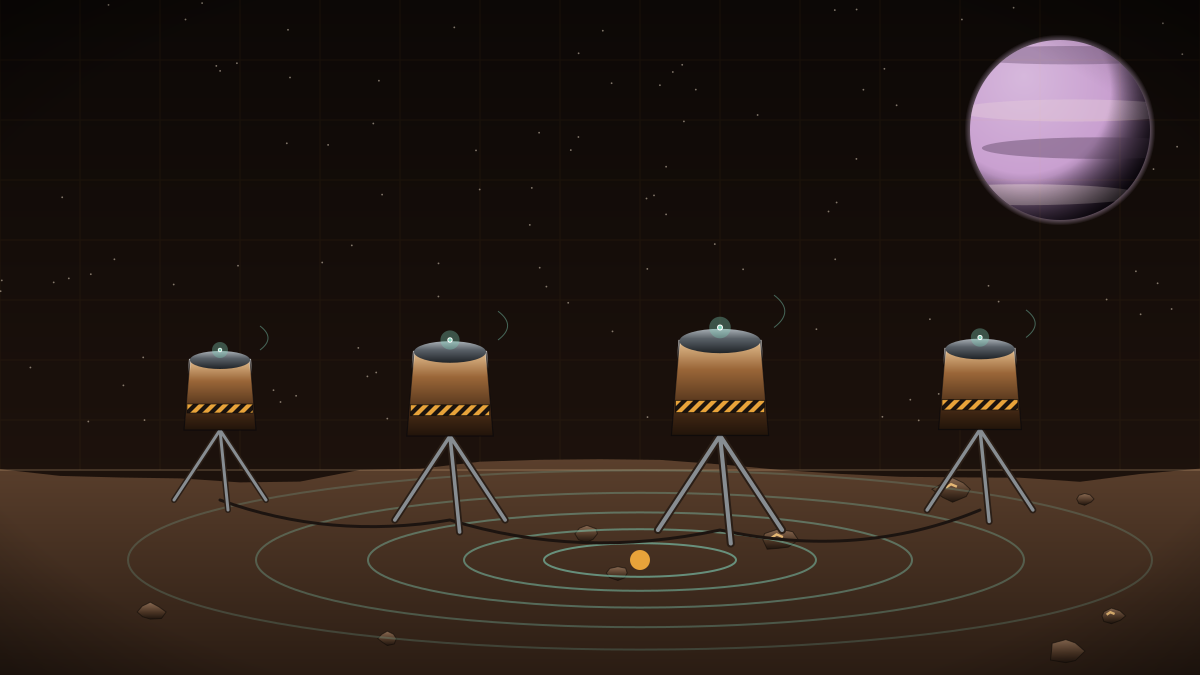
Dense metal is heavy, and heavy things pull slightly harder. The Gravwell Gradiometer Array turns that simple idea into the guild's most powerful deep-search instrument. It measures tiny changes in the gravity gradient as it passes over a body, and from those changes builds a picture of where unusually dense rock, typically iron-nickel with platinum-group metals and iridium, sits beneath the crust.
The array is a 22-metre truss carrying four superconducting gradiometer pods. It is normally mounted on the keel of a Valkyrie Survey Corvette and flown in low orbit, where it covers a 400 km survey swath per pass. Gravity anomalies can be resolved to depths of 12,000 metres, far deeper than any magnetometer, which is why the Gravwell finds targets that Pickaxe drones miss entirely.
Two operators fly the survey from the corvette's mission bay, and a deployment crew of four keeps the cryogenic pods cold and calibrated. A hydrogen-oxygen fuel cell stack supplies 46 kW, independent of the host ship's power bus to keep electrical noise out of the readings. The 2,200 kg payload includes a star tracker, a laser altimeter and spare cryocooler heads.
The first operational unit entered service on 30 July 2185 and is still in production, with output limited to about eight arrays a year by the supply of superconducting sensors. Gravimetry Data Scientist Liang Qiao built the processing chain behind the Vesta Gravity Model v3, and the Gravwell's survey led directly to the discovery of the Kerwan Rhodium Vein beneath Ceres.
An array costs 18.9 million credits, excluding the corvette. Several clients, including Ganymede Magnetics Foundry and Garonne Catalyst Metals, lease a unit with a guild crew instead of buying outright.