Equipment
Corehound Deep Core Drill
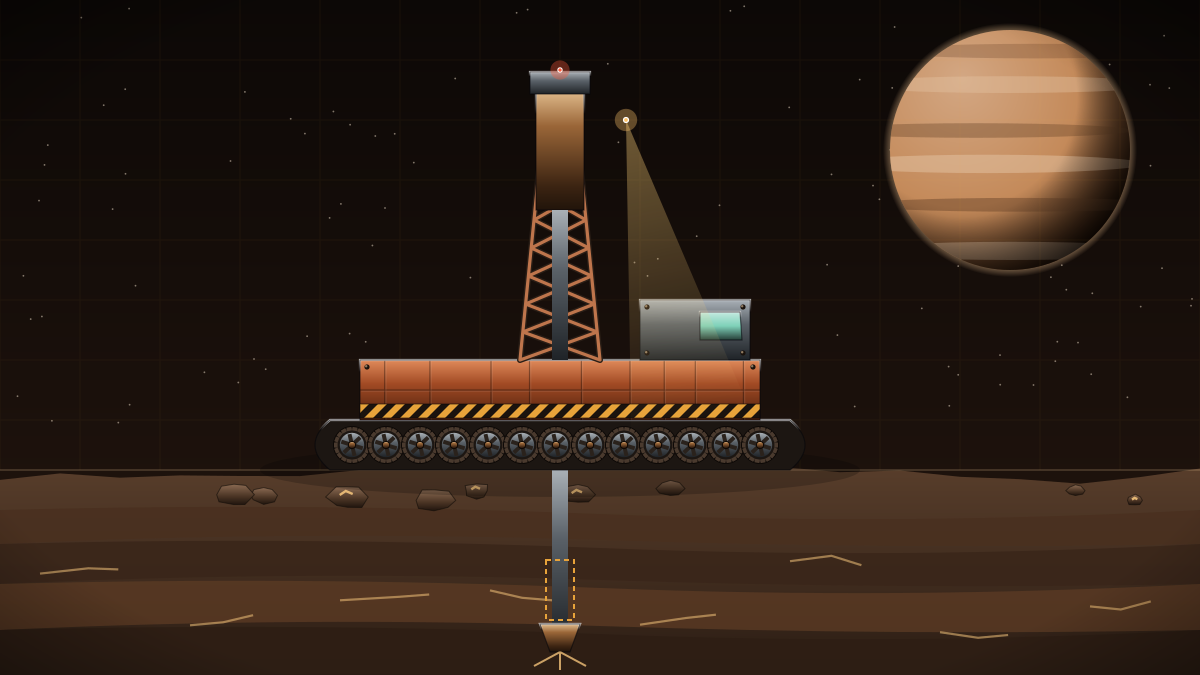
Magnetometry and gravity surveys can tell you where metal probably is. Only core in a box tells you how much, and the Corehound Deep Core Drill has been providing that proof since 21 March 2172. It is the oldest design still in the Ferrovane catalogue and, by credits spent, the most important: almost every registered claim the guild auctions has Corehound core behind its grade figures.
The rig is 34 metres long when stowed and stands upright on four splayed anchor legs, with a mast that can be tilted 60 degrees for angled holes. A compact fission microreactor provides 420 kW, enough to turn a diamond-impregnated bit through basalt, frozen breccia or solid nickel-iron. Continuous core is recovered to a depth of 2,400 metres, and the directional steering head can deviate a hole up to 2 km laterally to intersect a lode from a single pad.
Three operators run the drill in shifts, supported by a deployment crew of six for casing, core logging and anchor maintenance. The 9,500 kg core magazine holds about 1.6 km of 63 mm core before it has to be swapped, and every metre is photographed, scanned and logged into the Ceres Core Library.
A Corehound arrives in pieces in the hold of a Leviathan Ore Hauler and is lowered to the surface in two loads by a Wren Microlifter. Drill Master Bastien Kowalczyk's crews proved the Cinder Tor Iridium Lode on Vesta with nineteen Corehound holes, and Io Scandium Works keeps two rigs shielded against Jupiter's radiation belts.
A complete rig costs 12.4 million credits, including the reactor lease, three spare bit sets and a crew certification course at the Vesta Toolworks.