Field report
Sixty-four eyes: first field trial of the Swarm Prospecting Beacons
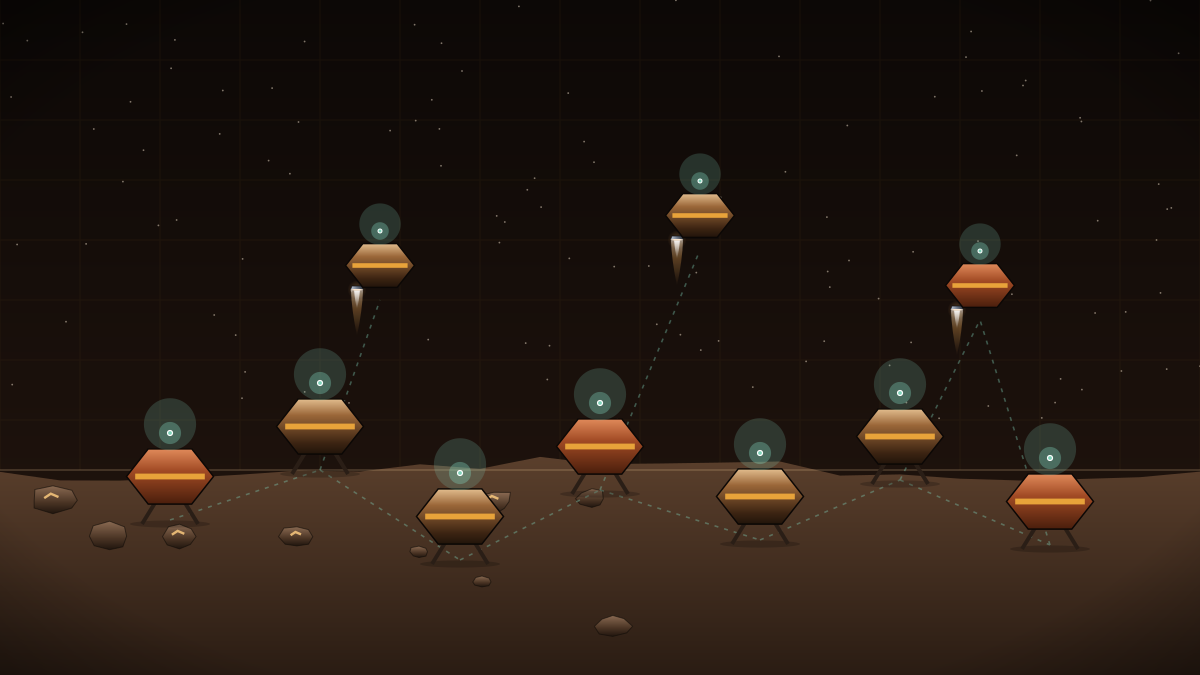
A prospector can only stand in one place at a time. That is the oldest problem in our trade, and the Swarm Prospecting Beacons are the Toolworks' attempt to solve it. Instead of one big instrument, we scatter 64 small ones across a landscape and let them talk to each other. After a year in the lab, the prototype had its first field trial this season.
Each beacon is under a metre long, carries magnetometer, thermal and neutron sensors, and runs on thin-film solar with a betavoltaic backup. A full pack weighs 96 kilograms and draws less than a kilowatt in total. The beacons spread across up to 300 kilometres and can sense signals from as much as 150 metres below the surface. One operator and a helper deploy them.
We ran two trials. On Callisto, Paulo Teixeira's crew dropped a pack across the Valhalla basin to rank cold traps for helium-3, and it cut their dry holes by more than half. In the Belt, we scattered a second pack over a small metal asteroid and compared the results with a Pickaxe drone grid. The swarm's map was coarser, but it kept watching for weeks, which no drone can do.
Not everything worked. Three beacons on Callisto rolled into shadow and lost power. Two in the Belt bounced off the surface entirely and are still out there somewhere. The new version will have better feet and a small anchor.
We also tested the swarm alongside Claimstake Survey Markers, feeding both into ClaimGrid. Seeing live survey data inside the claim boundaries is very useful. The beacons remain a prototype, priced at 1.9 Mc per pack, and we are looking for three more crews to trial them next season.