Field report
Six weeks in a Valkyrie over the Kerwan basin
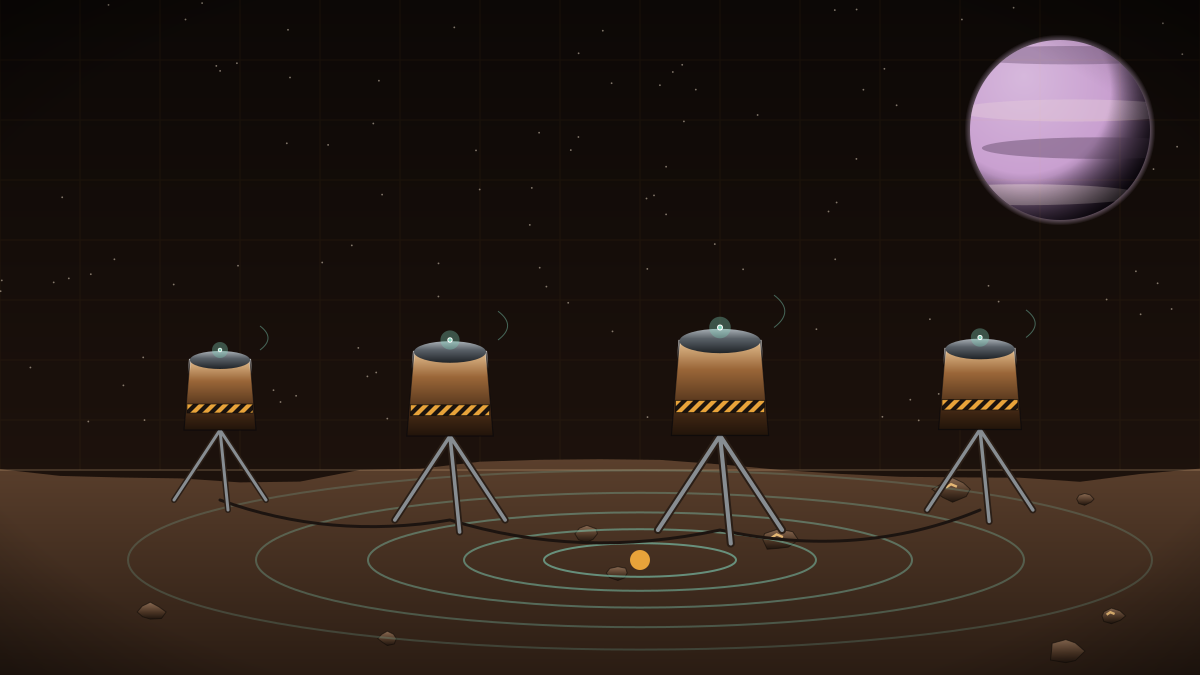
Most of my working life is spent flying very slowly and very low over worlds that would rather I did not. Six weeks over the Kerwan basin on Ceres this year were a good example: 280 survey passes at an altitude where a pilot cannot afford to daydream, with a Gravwell Gradiometer Array hanging off the hull.
The Valkyrie Survey Corvette is the ideal platform for this. It is stable, it has room for the four-person array crew and their racks, and it can hold a precise line for hours. The Gravwell itself is 22 metres of sensor housing and 2,200 kilograms of instruments, powered by a 46 kW fuel cell stack. It sees density contrasts as deep as 12 kilometres and across a 400-kilometre swath, but only if the pilot keeps the corvette steady.
A gradiometer hates vibration. Any thruster firing ruins a few seconds of data, so we fly long ballistic arcs with the engines quiet and correct only at the ends of each line. My copilot and I took four-hour shifts. Liang Qiao on Ceres processed each day's data overnight and sent back a list of passes to repeat.
In week four the data lit up over the basin floor: a compact dense body between 600 and 1,400 metres down. We parked the corvette and launched two Pickaxe Survey Drones to fly a tight magnetometry grid over the anomaly. Their data confirmed metal. That body is now the heart of the Kerwan Rhodium Vein.
I fly for the Guild because the work matters. Each pass is dull, but a clean dataset can be worth more than a mine. If you are a Halcyon-rated pilot and like precision flying, the Survey fleet is always hiring.