Equipment
Pickaxe Survey Drone
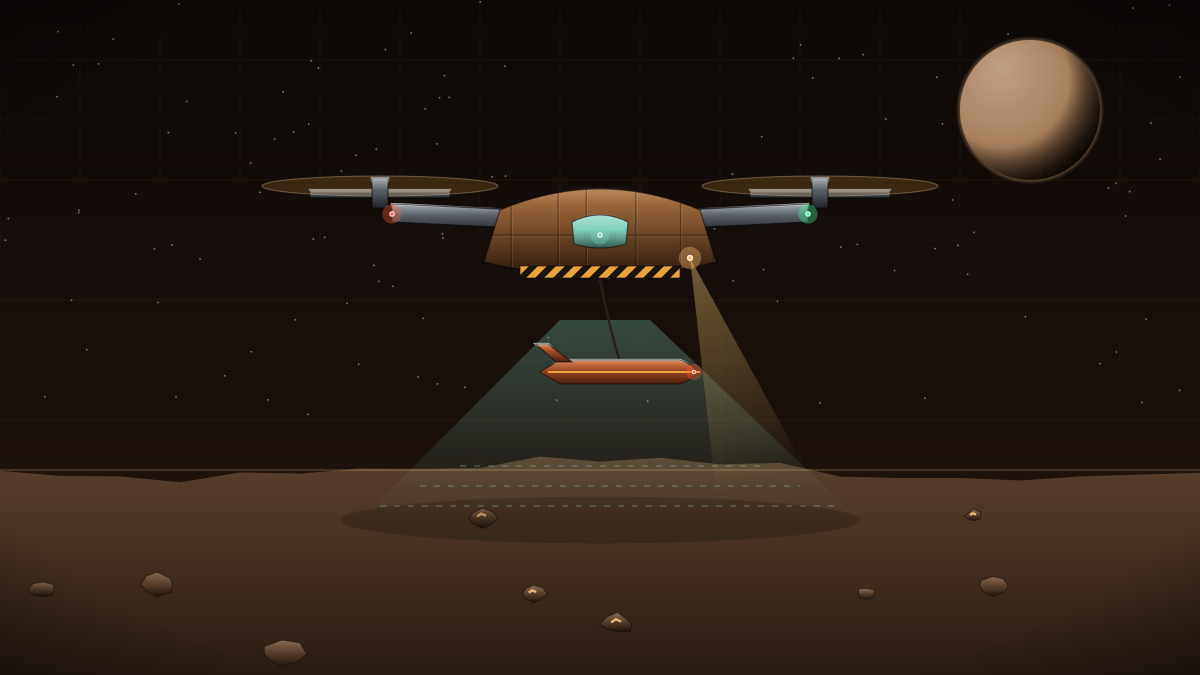
The Pickaxe Survey Drone is the first thing a Ferrovane crew unpacks when it arrives at a new rock, and usually the cheapest instrument on the manifest. Hester Mbeki's Toolworks team at Rheasilvia designed it in 2178 after the guild grew tired of renting slow orbital magnetometer time; the first production unit went into service on 3 June 2179, and more than 1,400 have been built since.
At heart it is a caesium-vapour magnetometer on a stiff carbon boom, slung beneath a two-metre airframe that flies on cold-gas thrusters in vacuum and a folding rotor where there is any atmosphere worth biting. One operator flies it, with a second crew member handling launch, recovery and battery swaps. A lithium-sulfur pack topped up by a fold-out solar wing gives it an average draw of 3.2 kW and a single-sortie survey line of 120 km, which is enough to grid a small asteroid in an afternoon.
Magnetic anomalies show up from the surface to roughly 400 metres down, deep enough to separate a genuine metallic core from a rubble pile with a thin skin of meteoritic iron. The 18 kg payload bay can swap the magnetometer for a gamma spectrometer or a lidar head, and many crews fly both on alternate passes.
Pickaxes are usually launched in pairs from the cargo bay of a Valkyrie Survey Corvette, or tossed from the ramp of a Wren Microlifter on smaller jobs. Raw readings stream into the open MagFuse Inversion Engine, which turns them into ranked drill targets. The Belt Aeromagnetic Grid 2186, covering 1,840 bodies, was flown almost entirely with Pickaxe swarms.
A drone costs 0.85 million credits, including spare props, two battery packs and a year of firmware updates. Magnetometry Lead Rukmini Sato runs the operator course on Ceres; most prospectors are flying solo survey lines within a week.