Field report
Thumping Tharsis: listening for dysprosium dykes
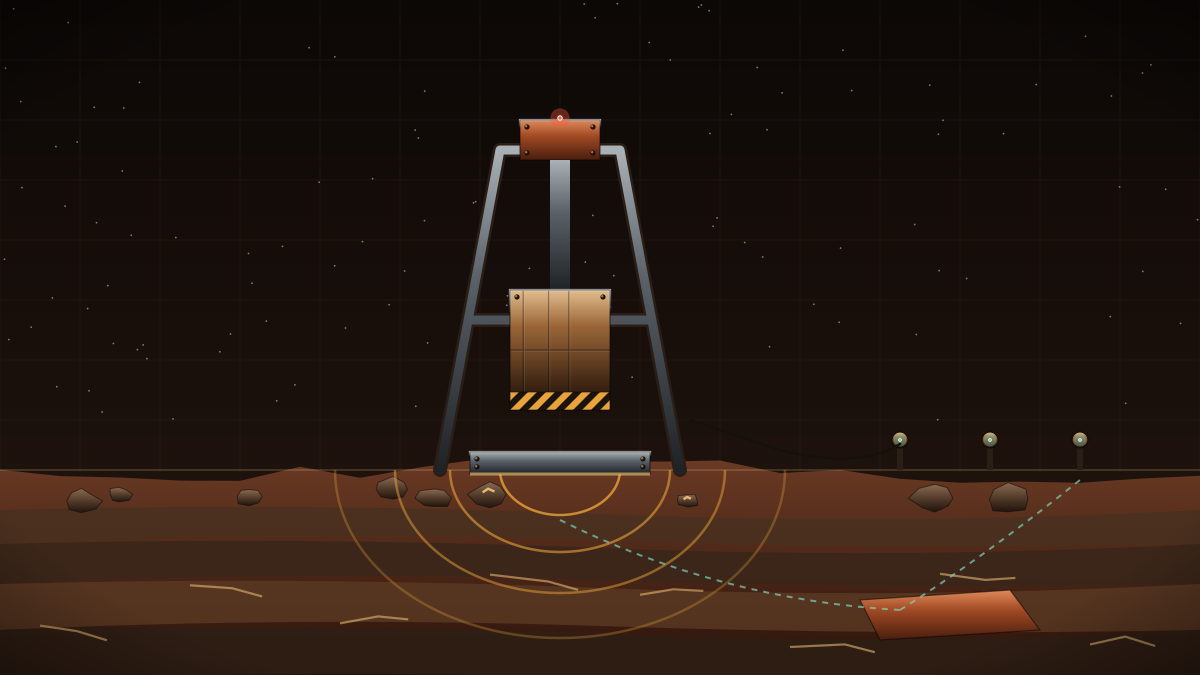
Dysprosium is the metal everyone in the magnet business worries about. Without it, high-temperature motors lose their strength, and there is never quite enough. On the flank of Tharsis we think we have found a serious new source, buried in carbonatite dykes between 200 and 1,100 metres below the Martian surface. The question was how to see them.
Magnetometry was little help, because Martian basalt is magnetically noisy. Gravity showed broad trends but no detail. So we turned to sound. The Thumper Seismic Mapper slams a heavy weight onto the ground in a precise rhythm and listens to the echoes on a spread of geophones up to 25 kilometres long. Its methane-oxygen turbine delivers 260 kW for the hammer, and the system can image structure down to 6,000 metres.
We shot 1,600 square kilometres over one Martian summer. The dykes appear in the reflection volume as narrow, steep, bright planes cutting the layered lava flows, and once you know what to look for you find dozens. The Tharsis Seismic Volume holds every one of them; it stays restricted to members until 2189, when it becomes public.
Then came the drill. The Corehound reached the first dyke at 640 metres and stayed in mineralised rock for 82 metres. Laboratory assays show 310 g/t dysprosium, 48 g/t terbium and 2,400 g/t neodymium. Those grades would make most Earth-side rare-earth mines blush.
The licence is still pending with the Martian authorities, and nobody will move ore until it clears. Meanwhile Kofi Mensah-Hart's rover crews are mapping surface outcrops along strike. If the dykes run as far as the seismic data suggests, Tharsis could keep the magnet foundries busy for decades.