Field report
Reading a rock in eight seconds: a field guide to the Spectra Assay Lance
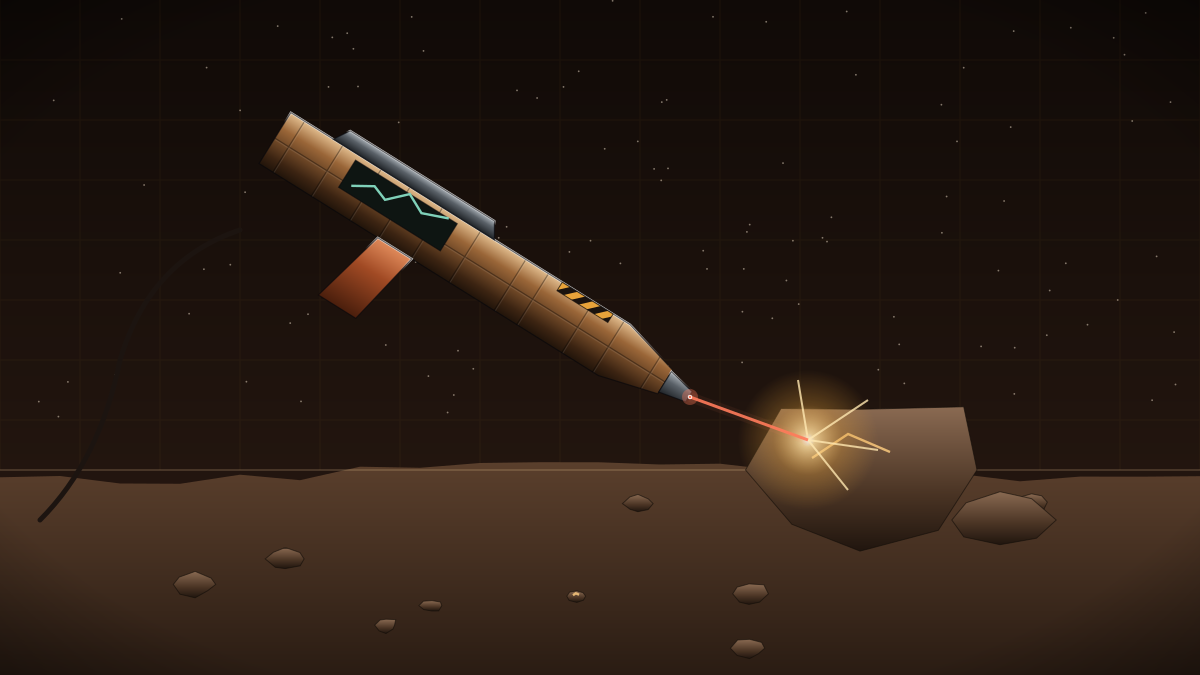
Every new member gets a Spectra Assay Lance in their kit, and most of them use it wrong for the first month. That is not their fault. Laser-induced breakdown spectroscopy looks like magic: point, pull the trigger, and eight seconds later the screen tells you how many grams per tonne of neodymium or platinum sit in the rock. But a LIBS reading is only as good as the surface you fire at.
Here is what is actually happening. The lance fires a pulsed laser at up to 12 metres standoff, vaporising a pinhead of rock into a glowing plasma. As the plasma cools, each element emits light at its own wavelengths, and the spectrometer reads those lines. Repeated pulses drill a shallow pit, so you can profile the top 5 centimetres of a sample, layer by layer.
Mistake one: firing at dust. Weathered crust on Vesta and Phobos is often depleted in the metals you care about. Brush or chip a fresh face first. Mistake two: a single shot. Take at least twenty pulses on five spots and average them. Mistake three: skipping calibration. Fire at the reference disc in the lid every morning; the AssayKit toolkit will tell you if your detector has drifted. Mistake four: ignoring the angle. Hold the beam within fifteen degrees of perpendicular. Mistake five: trusting the lance over a core. LIBS is a guide, not a resource estimate.
Done properly, our lances agree with laboratory fire assay to within about 8 per cent for platinum-group metals and 5 per cent for the rare earths. At 0.22 Mc each they are the cheapest assay instrument in the Guild, and the 2 kg sample cache means you can bring your best chips home for the lab.
If you want to check your technique, bring your lance to any assay workshop at the Rheasilvia Toolworks. My team will happily shoot alongside you and compare numbers.