Equipment
Spectra Assay Lance
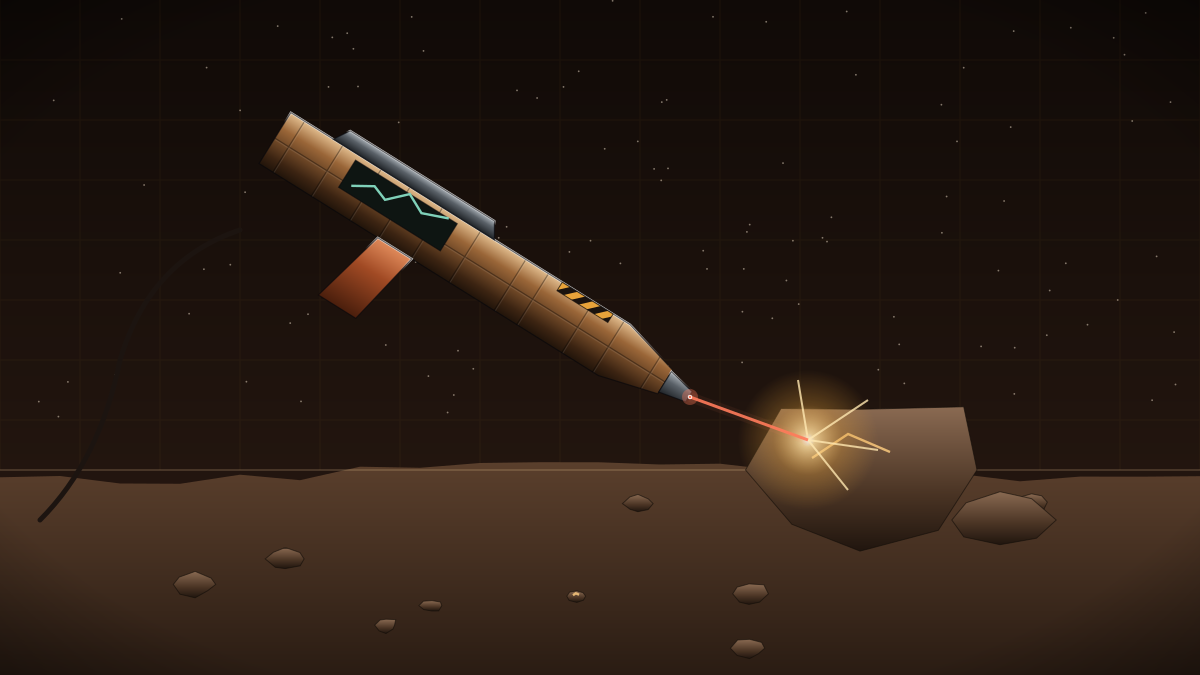
Ask a Ferrovane prospector which tool they would keep if they could only keep one, and most will point to the Spectra Assay Lance on their hip. It is a one-metre handheld laser-induced breakdown spectroscopy (LIBS) instrument: it fires a pulsed laser at a rock, turns a pinhead of the surface into glowing plasma and reads the light to work out what elements are present and in what concentration.
The Lance entered service on 11 February 2181 and has since become the guild's standard for on-the-spot grade checks. One person operates it, wearing it like a rifle with a shoulder stock. It has a laser standoff of 12 metres, so you can assay an overhang or a tumbling boulder without touching it, and by firing repeated pulses into the same spot it profiles down about 5 centimetres to see past dust and weathering rinds.
A solid-state lithium cell powers it at 0.12 kW, good for roughly 3,000 shots per charge. Results appear in about four seconds as element-by-element estimates in grams per tonne for iridium, platinum, rhodium, neodymium, dysprosium, scandium and some forty other elements, calibrated against reference standards maintained by Chief Assayer Imani Oduya's laboratory on Vesta. A 2 kg sample cache holds chips for later confirmation in the lab.
The open AssayKit LIBS Toolkit runs on the Lance's firmware, so crews can tune peak fitting for unusual mineralogy. Lances ride on Lodeseeker rovers, in the cabin of every Wren Microlifter and aboard Shackleton Platinum Exchange inspection teams, who use them to check incoming bullion.
At 0.22 million credits it is the most widely sold item in the catalogue: more than 9,000 have shipped to members and clients across the Belt, Mars and Luna.