Field report
Pinning a rubble pile: how we anchored Hollow Sister
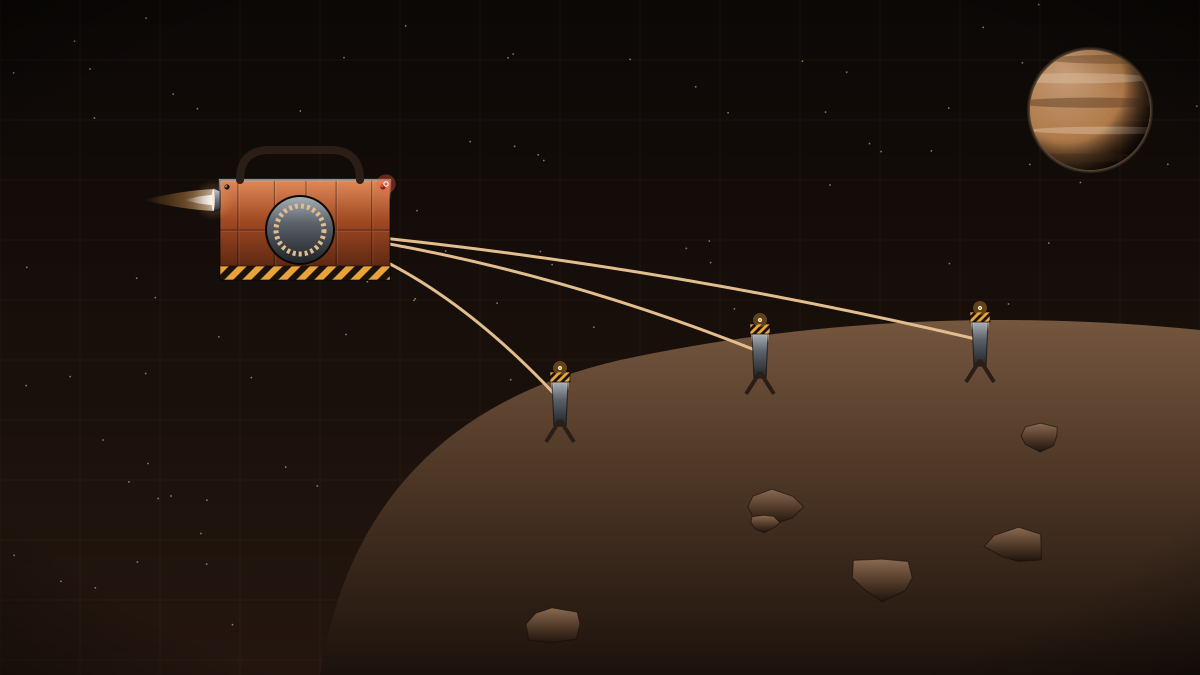
People who have never worked a rubble pile imagine landing on a rock. Hollow Sister is not a rock. It is a loose bag of boulders, gravel and dust held together by almost nothing, rotating once every five and a half hours, and if you set a boot on it carelessly you will simply sink, or bounce off into the dark. Before anyone could take a sample, my rigging crew had to pin it down.
We started with a Pickaxe Survey Drone. Its magnetometer mapped where the metal-rich boulders clustered, because those are the only places an anchor will bite. Cohesive patches showed up on the drone's grid as tight magnetic highs; the loose regolith in between read as quiet, soft ground.
Then came the anchors. Each Tether Anchor Kit drives a spike up to 18 metres into the pile and pays out 300 metres of braided tether to a winch powered by a 6.5 kW supercapacitor bank. One kit holds 3,200 kilograms. We set twelve of them in a ring around the equator and clipped every tether to a Basilisk Salvage Tug holding station overhead. Over nineteen hours the tug fired short, gentle burns against the spin, and the pile slowed from a 5.5-hour rotation to just over eleven. Gentle is the key word. Pull too hard and the anchors simply rip out with a fountain of gravel.
With the spin halved, the sampling team could walk the surface on tethers and fire their Spectra Assay Lances into fresh faces. Early readings match the auction notice: about 38 g/t platinum, 19 g/t palladium and 4.1 g/t rhodium in the metal-rich clasts.
Hollow Sister goes under the hammer as lot 7 at the next Ceres Claims Auction. Whoever wins it inherits our anchor ring, free of charge, and the TetherPlan files that show exactly how much load each spike carried. Rigging is a craft. Please do not improvise it.