Field report
Coring into the Conamara brine
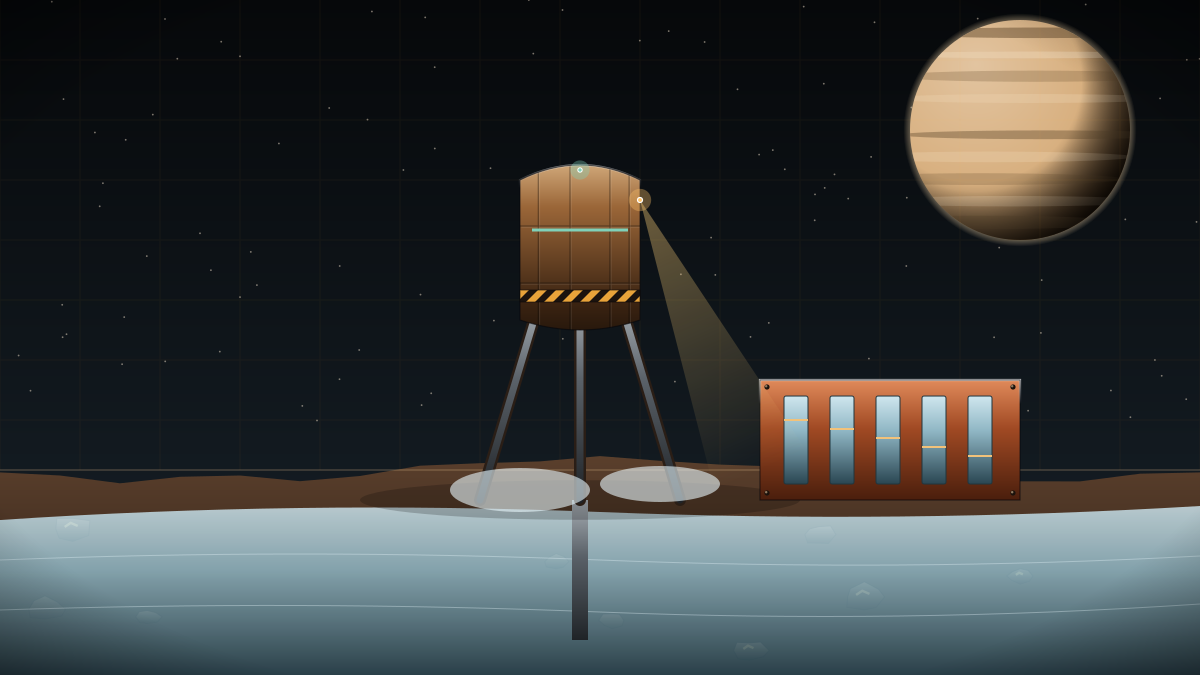
Europa's ice shell is not a solid block. In chaotic regions like Conamara, the ice has fractured, refrozen and trapped pockets of salty water hundreds of metres below the surface. We wanted to know what those pockets contain. This season, working with the Europa Subsurface Assay Institute, we found out.
Our tool was the Cryo Ice-Core Sampler, a nine-metre melt-and-core system powered by a plutonium-238 generator that gives a steady 2.4 kW. It can reach 900 metres, travel on a sled for up to 12 kilometres between holes, and carries 380 kilograms of sample canisters. Crew of three: two operators and me.
Drilling ice at minus 170 degrees is slow. We advanced about 30 metres a day, sealing each core into a cryogenic canister the moment it came up. At 412 metres the drill broke into the first lens of brine, and the pressure gauge jumped. Over the season we sampled six lenses between 400 and 850 metres deep.
The brine is remarkably rich. Lithium averages 210 grams per tonne and rubidium 35 g/t, with a trace of helium-3 at about 6 parts per billion. The lithium is the real prize: it is essential for batteries everywhere from Olympus Ring to the Jovian outposts.
Conamara is a research claim, held by the Institute, and nothing will be extracted until we understand the brine's chemistry and possible biology. All the isotope data and core photographs are in the Jovian Volatiles Census, released under ODbL. Europa rewards patience, and we are only beginning.