Equipment
Sieve Ore-Sorting Rig
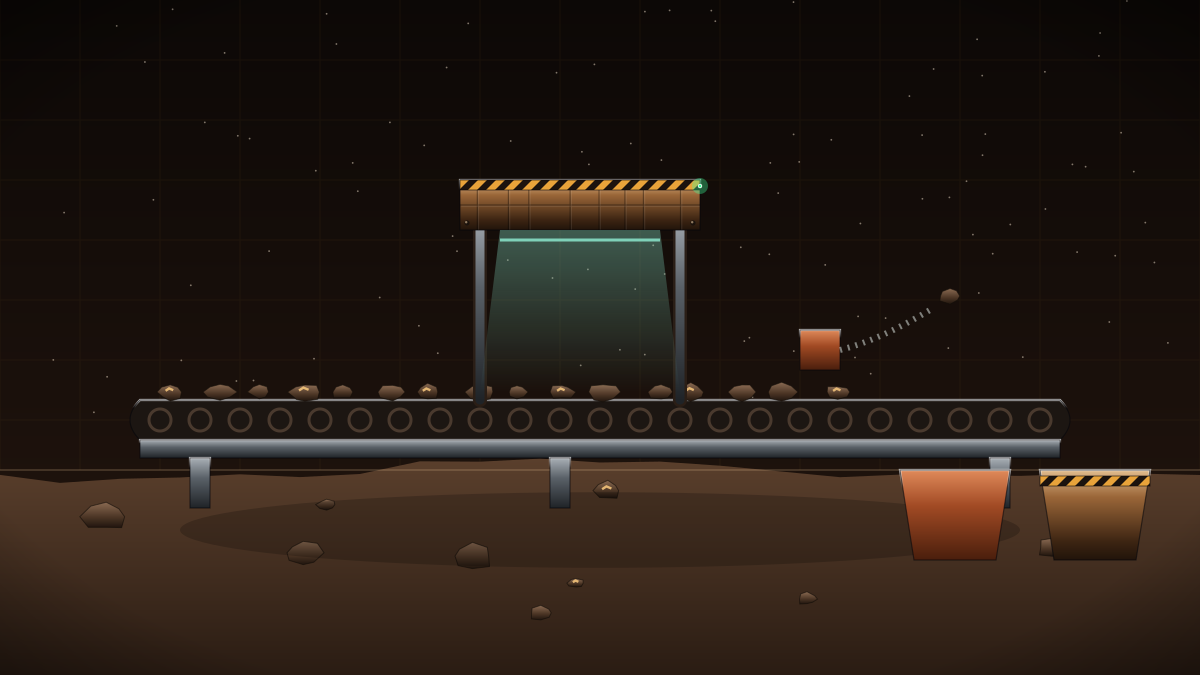
Most rock dug from a claim is waste. The Sieve Ore-Sorting Rig decides, one fragment at a time, what is worth keeping. It is a 26-metre conveyor line that scans every piece of crushed ore with X-ray transmission and a bank of LIBS lasers, then fires precisely timed jets of gas to knock the barren pieces off the belt.
The rig handles 40,000 kg per hour, its listed payload, and typically rejects 55 to 70 per cent of feed as waste while keeping more than 95 per cent of the metal. On the Loki Margin Scandium Crust on Io, a Sieve lifts scandium grades from 160 g/t in raw crust to over 400 g/t before the material goes to a refinery, cutting the cost of the next step by more than half.
Two operators supervise the line and a deployment crew of four handles crushing, maintenance and sensor calibration. Power, 640 kW at full throughput, normally comes straight from an Ironmonger Field Refinery's bus, with a fuel-cell stack as backup. The rig is a processing tool, so survey range and depth are listed as zero.
Ore-Sorting Engineer Eamon Dubois designed the current sorting algorithms, which learn from the AssayKit LIBS Toolkit's spectral libraries. The Sieve entered service on 2 August 2180. Vesta Crucible Refining Combine runs five, Olympus Ring Alloyworks two, and Io Scandium Works one in a radiation-hardened enclosure.
A rig costs 9.8 million credits. It travels in modules in a Leviathan Ore Hauler and is assembled on site in about nine days.