Equipment
Lodeseeker Prospector Rover
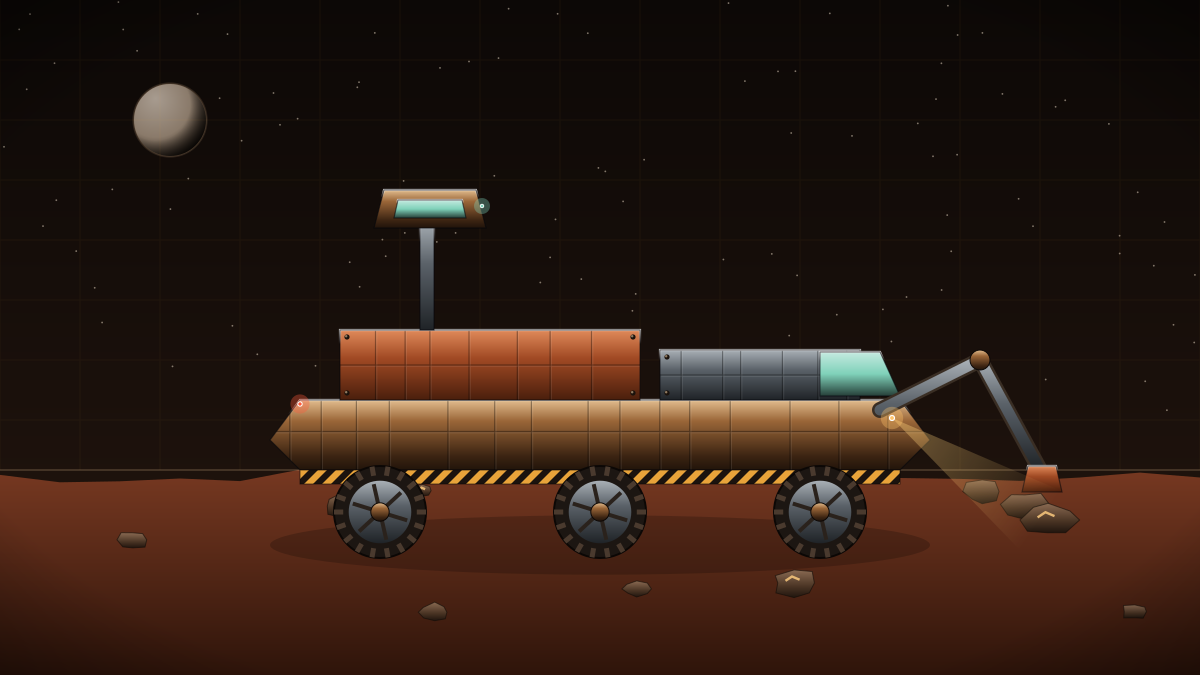
Where the Pickaxe drone looks from above, the Lodeseeker Prospector Rover gets its wheels dirty. It is a six-metre, six-wheeled field vehicle that crawls across regolith, ice and frozen lava, taking samples and radar soundings as it goes. The first Lodeseekers rolled out of the Rheasilvia Toolworks on 14 September 2176, and the current batch is the fourth revision of the chassis.
Power comes from an americium-241 radioisotope generator that delivers a steady 1.8 kW day and night, so a Lodeseeker never has to wait out a long Martian dust storm or the eighty-hour night on Phobos. On a full traverse it can cover 850 km before it needs maintenance, at a walking pace that rarely tops 9 km/h. Ground-penetrating radar images layering down to about 30 metres, which is ideal for mapping placer-style rare-earth enrichments and buried sulfide lenses.
Two operators drive and run the instruments from a pressurised cab; a third crew member normally rides along to handle samples. The 640 kg payload covers a coring arm, a sealed sample carousel and a mount for a Spectra Assay Lance, so the crew can read grades in grams per tonne within seconds of breaking a rock open.
Lodeseekers are dropped onto site by a Wren Microlifter, which can lift a fully fuelled rover from orbit to the surface in a single hop. Rover Crew Chief Kofi Mensah-Hart has logged more than 11,000 km in them on the Tharsis flank, and the Phobos Regolith Syndicate operates six units around Stickney crater.
A Lodeseeker costs 4.6 million credits, including the radioisotope core lease and sample-handling training. Most of the 14,200 sample points in the Phobos LIBS Assay Atlas were collected by Lodeseeker crews.